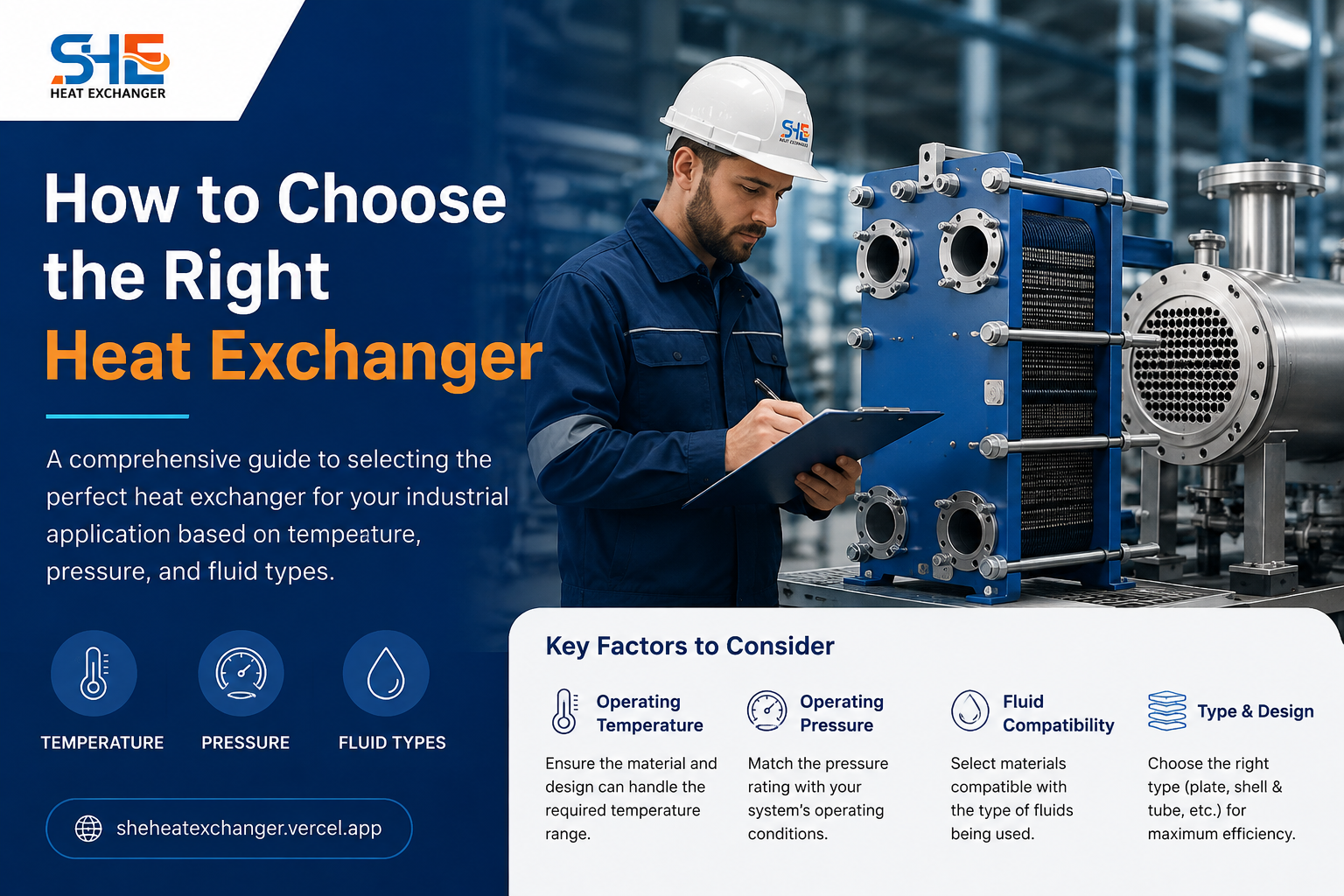
Selecting the right industrial heat exchanger is one of the most critical engineering decisions for any plant or processing facility. The correct choice ensures maximum thermal efficiency, low operating costs, reliable uptime, and compliance with strict safety standards.
1. Key Factors to Evaluate Before Selecting a Heat Exchanger
Before finalizing any unit, several core process parameters must be thoroughly evaluated:
- Thermal Duty & Heat Load: The total amount of heat that must be transferred between process streams per hour (kW or kcal/hr).
- Inlet & Outlet Temperatures: Operating temperature ranges on both hot and cold sides.
- Flow Rates & Fluid Types: Liquid-to-liquid, gas-to-liquid, steam-to-water, or oil cooling applications.
- Design Pressure & Pressure Drop: Maximum permissible pressure drop on both tube and shell/plate sides.
- Fouling Tendency & Corrosiveness: Chemical composition of the fluids that dictate metallurgy requirements.
2. Comparing Common Heat Exchanger Types
A. Shell & Tube Heat Exchangers
Best For: High pressure (>30 bar), high temperature (>250°C), corrosive or hazardous chemical processes, power plants, and refineries.
Advantages: Extremely robust, handles thermal expansion easily, easy to inspect and mechanically clean tube bundles.
B. Plate Heat Exchangers (PHE)
Best For: HVAC systems, dairy processing, pharmaceuticals, food & beverage, and liquid-to-liquid cooling.
Advantages: Maximum thermal efficiency, compact footprint (up to 80% smaller than shell & tube), easy to expand capacity by adding plates.
C. Air Cooled Heat Exchangers (Fin-Fan Coolers)
Best For: Facilities with scarce water resources, power generation, gas compression, and remote industrial plants.
Advantages: Zero cooling water requirement, no water treatment costs, eco-friendly operation.
D. Industrial Oil Coolers
Best For: Hydraulic power packs, gearboxes, turbines, compressors, and industrial lubrication loops.
Advantages: Low pressure drop, protects critical bearings and moving machinery parts from thermal degradation.
3. Material Selection & Metallurgy
Choosing the right material prevents corrosion, scale buildup, and premature failure:
- Carbon Steel: Cost-effective for standard non-corrosive hydrocarbons and clean oil applications.
- Stainless Steel (SS304 / SS316L): Standard choice for food processing, pharmaceuticals, demineralized water, and moderate acids.
- Titanium & Hastelloy: Required for seawater cooling, high-chloride environments, and aggressive chemical processing.
- Copper & Copper-Nickel (CuNi 90/10): Excellent for marine cooling and lubrication oil systems.
4. Total Cost of Ownership (TCO) vs Capital Cost
While capital equipment cost is important, energy efficiency, ease of maintenance, availability of spare parts, and expected service life dictate the true total cost of ownership. Working with an experienced manufacturer ensures you receive thermal simulation and custom design tailored to your process.